University of Hertfordshire · 6CTA2021 Fashion Business Major Project · Bootcamp 3 · Thu 22 Oct
A problem is not a business yet.
From problem to opportunity, and the partners who make it possible. Morning: four terms, how to judge an opportunity, four real cases, six cross-industry collaborations. Afternoon: choose your opportunity and find the partner you are missing.
Image: The Seam repair service, Primark announcement (11 Mar 2026). Research reference, not an endorsement. Brand and partner copyright; retain credit. Classroom use only.
Recap · Bootcamp 1 · The Problem Hunt
Two weeks ago: you found a problem
The rule
A researchable problem, not a product you like.
The tool
The Direction Map: eight areas, one living sheet. It becomes section 1 of your PDF.
The discipline
Evidence notes and interpretation notes, kept visibly apart.
60 seconds, with your neighbour
Read your exit statement. Your neighbour asks: who would pay to make that barrier go away?
Bootcamp 3 · how today runs
Morning: learn to choose. Afternoon: choose.
AM · 10:00 to 12:30Lecture
10:00Recap and today10 min
10:10Part 1 · Problem to opportunity30 min
10:40Part 2 · Judging an opportunity25 min
11:05Break10 min
11:15Part 3 · Four real cases30 min
11:45Part 4 · Cross-industry partners45 min
PM · 13:30 to 16:00Workshop
13:30Warm-up quiz5 min
13:35Reopen your problem15 min
13:50Insight and three HMWs20 min
14:10Score and choose20 min
14:30Break10 min
14:40Partner match25 min
15:05Scenario swap20 min
15:25One-minute pitches25 min
15:50Exit ticket10 min
You leave with
One opportunity chosen with evidence, one partner you would need, one next test.
Part 1 · 10:10
From problem to opportunity
Four words people use as if they mean the same thing. They do not.
Image: Beth Esponnette and unspun, via Stanford d.school (11 Jun 2026). Research reference, not an endorsement. Brand and partner copyright; retain credit. Classroom use only.
Part 1 · four terms, one example · fictional teaching example
Problem, insight, opportunity, solution
01Problem
A barrier stops someone reaching an outcome, in a particular situation.
Running example
A worker has usable trousers with a broken zip, and cannot get them repaired before needing them again.
02Insight
An evidence-based reason why the barrier matters or persists.
Running example
To test: not knowing the price or return date makes repair feel harder than buying new.
03Opportunity
An opening to create value by improving that outcome.
Running example
Make local repairs easier to assess and arrange around working hours.
04Solution
One specific product, service or process to pursue it.
Running example
A priced repair menu with bookable collection and a confirmed return date.
The trap: starting at the solution card. An opportunity should leave room for more than one solution.
Fictional teaching example, not research findings. Source: research report, 21 Oct 2026.
Part 1 · four methods · each one is a question
Four ways to get from problem to opportunity
Tap a card: a one-minute caveman explainer in my voice.
Caveman version · 1 min
How Might WeIDEO.org Design Kit
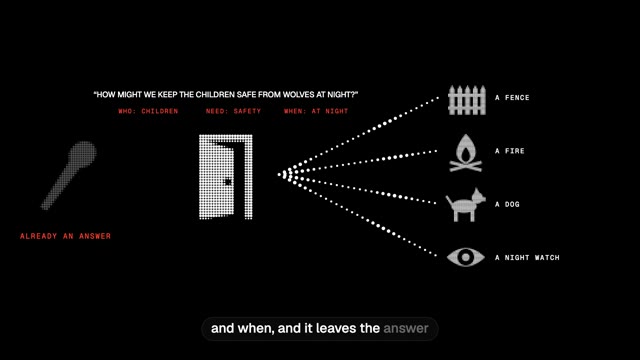
What open question turns this insight into a direction?
“How might we help workers arrange a reliable repair without disrupting their day?”
Rewording an assumption does not prove it.
Caveman version · 1 min
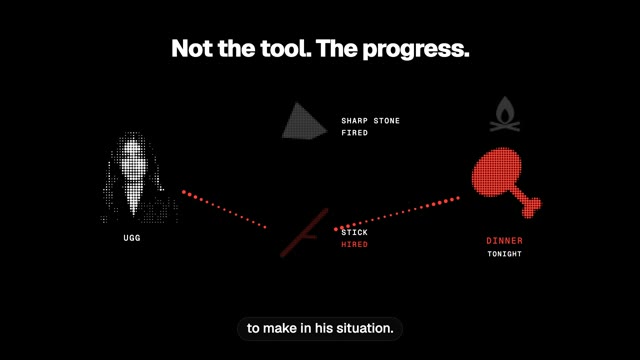
Jobs to be DoneChristensen et al., 2016
What progress is this person trying to make?
The job may be “be ready for work”, not “own a repair app”.
People rationalise after the fact. Ask about real episodes.
Caveman version · 1 min
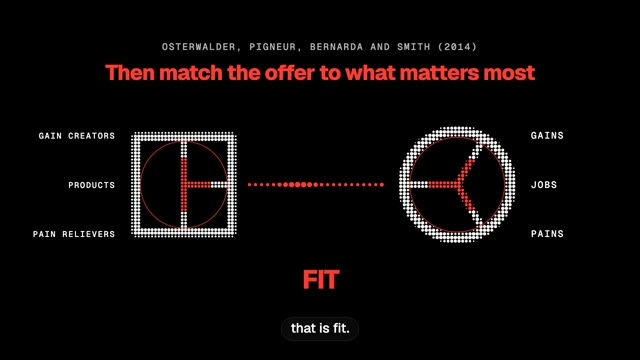
Value Proposition CanvasOsterwalder et al., 2014
Which jobs, pains and gains matter most?
Map the customer side first, then match an offer to the biggest pains.
A neat canvas can hold untested claims.
Caveman version · 1 min
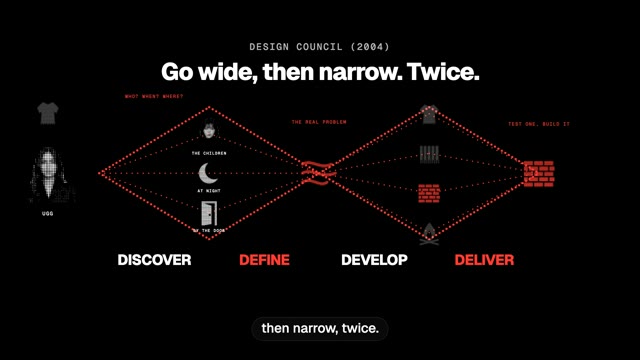
Double DiamondDesign Council, 2004
Have we explored widely before narrowing?
Discover and Define the problem; Develop and Deliver responses. Loop back when tests change it.
Not a one-way waterfall.
IDEO.org; Christensen et al. (2016); Osterwalder et al. (2014); Design Council (2004, current framework). All core sources historical.
Part 1 · framing it right
Four mistakes, and one problem with three openings
Jumping to a product
“People need an AI wardrobe app.”
FixWhich outcome is difficult, for whom, and what do they do now?
Too broad
“How might we fix fashion waste?”
FixName a person, a material flow, a place or a decision.
Too narrow
“How might we add a booking button to our app?”
FixReopen how the customer could arrange it at all.
No payer
“Everyone says a free repair service would be useful.”
FixWho funds the skilled labour, handling and failed jobs?
One problem, three opportunity directions · pick one to investigate
1Make repair cost and turnaround predictable before someone commits.
2Make handover and collection fit around work or study.
3Help someone decide whether repair suits the garment and occasion.
Examples from the research report; fictional repair example.
Part 2 · 10:40
Judging an opportunity
Evidence, not excitement. And a market estimate you can actually defend.
Image: The Seam at Primark, Primark (11 Mar 2026). Research reference, not an endorsement. Brand and partner copyright; retain credit. Classroom use only.
Part 2 · judging an idea · step 1 of 2
Six questions, and how sure you are
Ask six questions · three tests: want it?can we do it?will it pay?
Want it?Do people really have this problem, and want it fixed now?Need and urgency
Want it?Does it happen often enough to matter?Frequency
Want it?Is what they use today really not good enough?Existing alternatives
Will it pay?How many of them can you actually reach?Reachable demand
Can we do it?Can you (or a partner) actually deliver it?Delivery capability
Will it pay?Who pays, how much, and is there money left after costs?Payer and economics
Score each one: how sure are you? · examples are invented
0
The evidence says noWe asked 10 people; none had the problem.
1
A hunch, or one person said so“My mum would use it.”
2
Several real people told us6 of 10 people we asked had a broken zip waiting.
3
We saw people do it or pay for it12 people booked a trial repair at £25.
U
We do not know yetNot zero. It goes on your list of things to test first.
IDEO desirability, feasibility, viability (B06), in plain words. Scale and examples are tutor-created and fictional.
Part 2 · judging an idea · step 2 of 2 · worked example, fictional
Three repair ideas, scored. Which would you chase?
The six questionsAClear price and return date before you bookBPick-up and drop-off around work hoursCHelp people decide: repair or replace?
Have the problem now?26 of 10 had a broken item waiting2same 6 of 1012 people said they were unsure
Often enough?1about twice a year each1about twice a year each1about twice a year each
Today’s option not good enough?2tailors give no price until they see it1most can drop off on a SaturdayUnot asked yet
Can we reach them?2one campus, one notice board2same2same
Can we deliver it?3price list done; partner tailor agreed1no driver, no van2a simple online checklist
Who pays, money left?Uwill they pay £25? test it0van costs more than a repairUnobody pays for advice?
Choose A
Most evidence, and we can deliver it.
Drop B
A 0 on money kills it, whatever else it scores.
Test first
A’s U: will people pay £25? Offer 20 trial bookings.
Fictional worked example (repair scenario from the research report). Every number is invented to show the method.
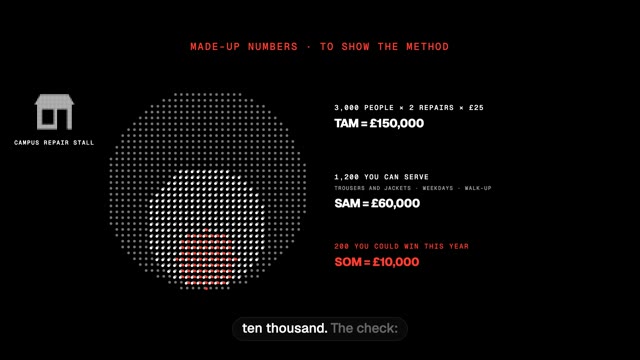
Part 2 · how big could it be? · a fictional repair stall
Count the people you can reach, step by step
3,000people
Everyone near you with the problem
All students and staff on one campus who own clothes worth repairing
3,000 × 2 repairs × £25£150,000TAM · The whole pizza
1,200people
The ones you can actually serve
Only trousers and jackets, only weekdays, only people who will walk to the stall
1,200 × 2 × £25£60,000SAM · The slices on your side of the table
200people
The ones you could win this year
Realistic for one stall and one partner tailor in year one
200 × 2 × £25£10,000SOM · What you can actually eat
These three are nested, one inside the other. Never add them up.
Is it worth it? · one repair
Customer pays£25
Tailor, thread, bag, your time− £18
Left over£7
A year at full capacity
400 repairs × £7 = £2,800
before rent, tax and anything else. A side hustle, not a business.
So change one lever
Raise the priceCut the costReach more people
Every number here is invented to show the method. Yours must come from counting: campus figures, a survey of real people, local tailors’ price lists.
Watch it: caveman version · 1 min
Fictional teaching example (research report, Charts/03). Not a UK market size or forecast.
Part 3 · 11:15
Four real cases
A repair service, a health-led product, a manufacturing technology, and a material business that failed first.
Image: Circulose material, Altor / Circulose (accessed 21 Oct 2026). Research reference, not an endorsement. Brand and partner copyright; retain credit. Classroom use only.
Part 3 · case 1 of 4
The Seam at Primark: repair where people already shop
The Seam repair service at Primark, Primark press images (11 Mar 2026). Stills: no official film verified.
~90%
of appointments pre-booked company claim, 12-week trial
12wks
Manchester trial, 2025
3
UK stores in the extension announced 11 Mar 2026
Problem
Repair is hard to organise
Owners struggle to find and book repairs; skilled makers struggle to reach customers.
Choice
Bring repair into the shopping trip
Simple same-day repairs in existing Primark stores, delivered by The Seam’s makers.
Limit
Primark subsidised the simple repairs
Would bookings hold at full price? Slots and completed jobs are not stated.
Ask the room
Which part of the barrier is access, and which is price?
Images: Primark / The Seam (11 Mar 2026). Research reference, not an endorsement. Brand and partner copyright; retain credit. Classroom use only.
Part 3 · case 2 of 4
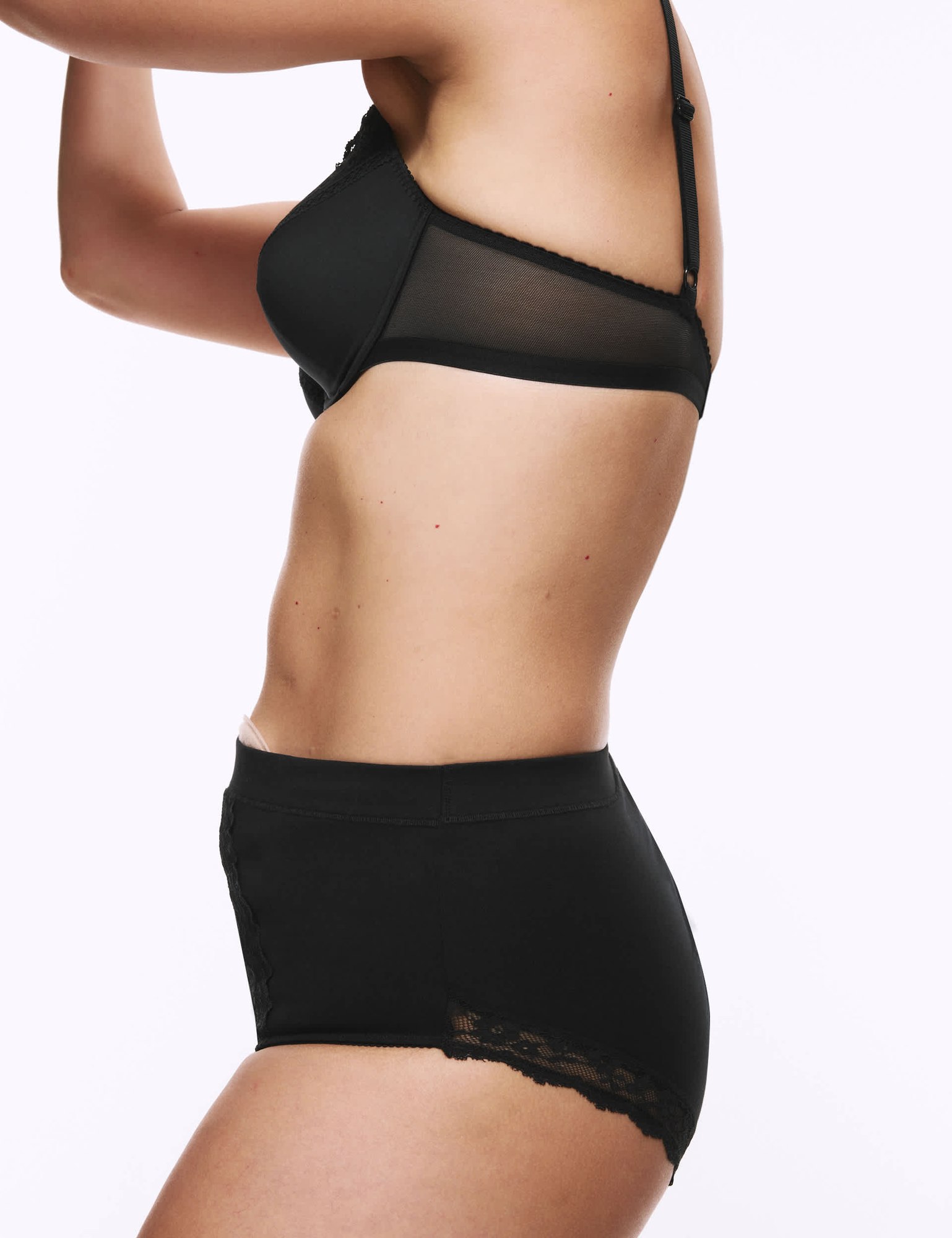
M&S stoma underwear: lived experience as evidence
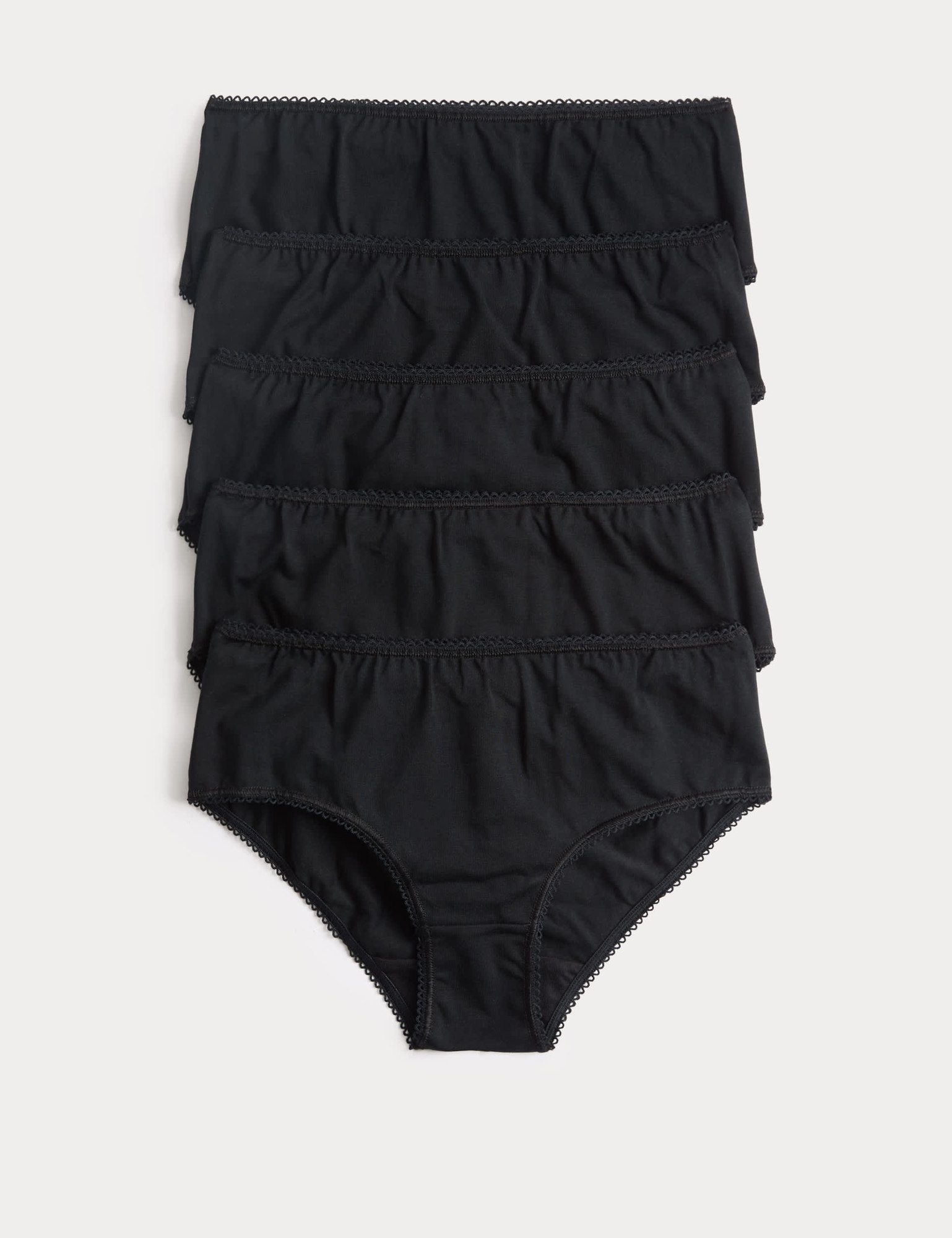
M&S stoma underwear and children’s range, M&S product images (accessed 21 Oct 2026).
20+
colleagues and customers involved M&S account
£18
three-pack, from 2024 launch price
2026
children’s range added 27 Feb 2026
Who
People living with a stoma
They wanted underwear that holds a bag, without losing everyday style and comfort.
Evidence
A colleague’s lived experience
Developed with 20+ colleagues and customers, and the charity Colostomy UK.
Unknown
Sales and profit: not stated
A 2026 children’s range shows the direction continued, not that it made money.
Ask the room
What did lived experience reveal that a trend report never could?
Images: Marks & Spencer (accessed 21 Oct 2026). Research reference, not an endorsement. Brand and partner copyright; retain credit. Classroom use only.
Part 3 · case 3 of 4
unspun: sell the capability, not another label
unspun 3D weaving loop, unspun website, 8 seconds, silent background loop (upload date unknown). Streams from unspun’s own server.
$32m
Series B reported Jul 2024
B2B
business model licensing + partnerships
?
machines in operation not stated
Problem
Waste and inventory risk
Conventional production makes garments before anyone buys them; fit is a problem too.
Choice
A B2B technology, licensed to others
3D weaving and software that brands and manufacturers can use. Machine licensing and partnerships.
Limit
Funding is not proof
Money raised does not show profit, machines running or emissions saved.
Ask the room
Why might selling the machine be a bigger opportunity than selling the jeans?
Film: unspun website (accessed 21 Oct 2026). Funding: trade press (Jul 2024). Research reference, not an endorsement. Brand and partner copyright; retain credit. Classroom use only.
Part 3 · case 4 of 4
Renewcell to Circulose: technology needs orders
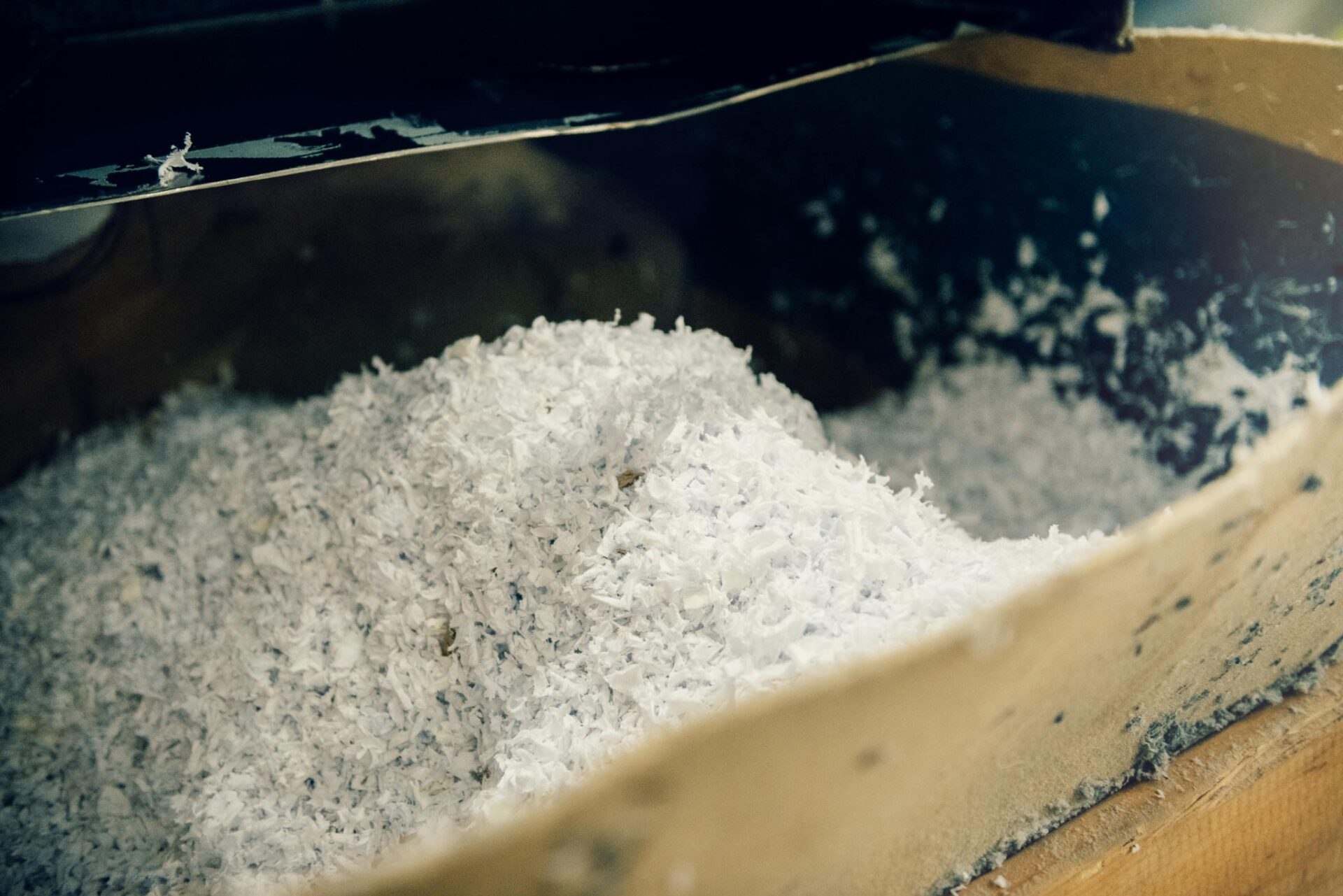
Circulose material, Altor / Circulose (accessed 21 Oct 2026). Still: an image of pulp is not proof that production has restarted.
Feb2024
Renewcell bankrupt H&M report, Jan 2025
Jun2024
Altor buys the assets now Circulose
?
contracted volumes not stated
Choice
Sell recycled pulp to the supply chain
A B2B material business: discarded textiles in, dissolving pulp out, for fibre makers.
Failure
Interest did not become orders
Brands liked it, but orders did not flow through the chain. Bankrupt in February 2024.
Restart
A sourcing deal, not a press release
As Circulose, a multi-year H&M agreement in June 2025. Volumes not stated.
Ask the room
Who must actually order and pay, at each step, for a feasible material to become viable?
Image: Altor / Circulose. Sources: H&M (30 Jan 2025), Circulose and H&M (27 Jun 2025), Carey (24 Jul 2024). Research reference, not an endorsement. Brand and partner copyright; retain credit. Classroom use only.
Part 4 · 11:45
Cross-industry collaboration
When the thing you are missing belongs to another industry: health, chemistry, software, fitness, logistics.
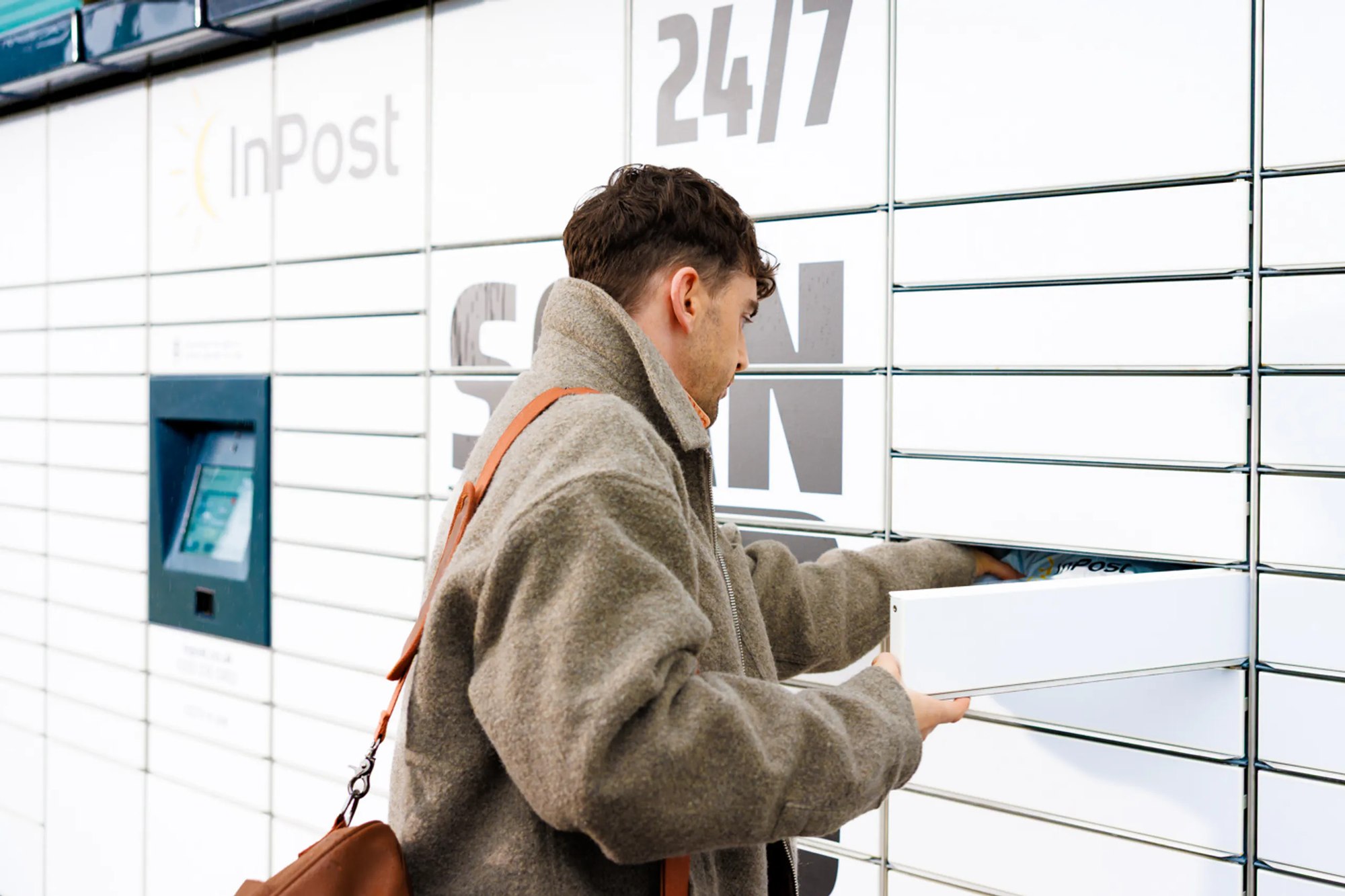
Image: InPost (accessed 21 Oct 2026). Research reference, not an endorsement. Brand and partner copyright; retain credit. Classroom use only.
Part 4 · what counts
Two logos are not a partnership
Co-branded drop
Two logos, one productPublicity and reach. After launch, nothing changes for the user.
Cross-industry collaboration
Two capabilities, one outcomeEach side brings something the other cannot readily build: knowledge, technology, operations, materials.
The test
What changes for the user after the publicity ends?
Six deal types · use the right word
PilotA bounded test
Co-developmentMaking something together
LicenceRights to use tech or IP
Equity investmentBuying part ownership
Sourcing or service contractBuying goods or a service
Joint ventureA new, jointly owned business
Definitions: research report (21 Oct 2026).
Part 4 · six real collaborations
Six industries, six missing capabilities
M&S×Colostomy UK
Health charity
Fashion bringsLingerie design and retail
Partner bringsLived experience and specialist insight
Co-developmentLaunch 2024, children 2026
Zara×Circ
Chemical recycling
Fashion bringsDesign and retail access
Partner bringsSeparating poly-cotton blends
Material collab + investment4-piece capsule, Aug 2024
ASOS×Microsoft
Software and AI
Fashion bringsRetail data and processes
Partner bringsCloud, AI, productivity tools
3-year agreement~50% of enquiries by agents (claim)
lululemon×Peloton
Digital fitness
Fashion bringsApparel and members
Partner bringsFitness content and platform
5-year partnershipContent strong, apparel slow
Vinted×InPost
Logistics
Fashion bringsResale marketplace
Partner bringsLockers and parcel network
Delivery contractRenewed Apr 2025, to 2027
H&M×Renewcell
Material recycling
Fashion bringsBrand demand and investment
Partner bringsRecycled pulp
Investment, then sourcing dealBankrupt 2024; new deal 2025
Sources: M&S (2024, 2026); Circ (15 Aug 2024); ASOS and Microsoft (2024, 2026); Peloton (2023 historical, 2024); InPost (23 Apr 2025); H&M and Circulose (2025). Images: the brands and partners. Research reference, not an endorsement. Brand and partner copyright; retain credit. Classroom use only.
Part 4 · collaboration · fashion x chemistry
Zara x Circ: what must the material prove?
Circ homepage film, Circ website, 16 seconds, muted loop (upload date unknown). Streams from Circ’s server; show 0:05 to 0:12.
4
pieces in the capsule Circ, 15 Aug 2024
50%
recycled textile in the fibre feedstock company figure
?
scale and net savings not established
Problem
Poly-cotton blends are hard to recycle
Separating the polyester from the cotton is the barrier to recovering useful material.
Exchange
Circ brings the chemistry, Zara the product
Zara tests a new material in saleable clothes; Circ gets a showcase and a route to adoption.
Read it right
100% and 50% have different bases
The fabric was 100% Circ Lyocell; its fibre feedstock was 50% recycled waste. Not 100% recycled garments.
Ask the room
What must Circ prove beyond making one capsule possible?
Film: Circ website (accessed 21 Oct 2026). Source: Circ (15 Aug 2024). Research reference, not an endorsement. Brand and partner copyright; retain credit. Classroom use only.
Part 4 · collaboration · fashion x digital fitness
lululemon x Peloton: a mixed result
Peloton App walkthrough, Peloton website (lululemon offer page), 24 seconds, muted. A generic app film, not the deal announcement.
5yrs
strategic partnership announced 27 Sep 2023
2
directions of supply content + apparel
?
financial terms not disclosed
Problem
Digital fitness needs content, every day
An engaging service needs ongoing classes and operations, not just a brand or a device.
Deal
Content one way, apparel the other
Peloton became lululemon’s exclusive digital content provider; lululemon became Peloton’s main apparel partner.
Result
Content strong, apparel slow
Peloton’s own letter, Feb 2024. No conversion or profit figures.
Ask the room
Which part of your customer experience should a partner supply, rather than you building it?
Film: Peloton website (accessed 21 Oct 2026). Sources: Peloton (27 Sep 2023, historical; 1 Feb 2024). Research reference, not an endorsement. Brand and partner copyright; retain credit. Classroom use only.
Part 4 · two numbers to read carefully
Read the claim, not the headline
Vinted × InPostresale x logistics · renewed 23 Apr 2025, to end 2027
GMV 2025
€10.8bn
Revenue 2025
€1.1bn
GMV = value of goods members traded. Revenue = what Vinted earned. Neither is caused by one delivery deal.
ASOS × Microsoftretail x software · 3-year deal, 7 Aug 2024
~50%
of customer enquiries handled completely by AI agents, says Microsoft (30 Apr 2026).
Partner’s own claim. No time window, no base number, no audit.
Sources: InPost (23 Apr 2025); Vinted (9 Apr 2026); ASOS (7 Aug 2024); Microsoft (30 Apr 2026). Bars to scale, same currency. Research reference, not an endorsement. Brand and partner copyright; retain credit. Classroom use only.
Part 4 · what a partner actually commits
Publicity is not a partnership
PublicityA logo and a press release
PilotA bounded test, staff and access for a set time
Purchase volumeA committed order or sourcing deal
PaymentMoney, ownership or a contract that carries risk
Why they work · Dyer and Singh, 1998
Complementary resources, shared learning, investment specific to the relationship, and governance that works.
How to run one · McKinsey, 2019
Aligned objectives, clear accountability, regular communication, and adjusting as things change.
The stress test
Who owns the customer, the data and the IP? Who pays if uptake is low? What survives if the pilot ends? What would make you stop?
Dyer and Singh (1998); McKinsey (21 Mar 2019). Both historical. The ladder is a teaching frame.
Part 4 · why it matters now · six dated facts
Why now: pressure, resale, rules
46%
of fashion executives expected conditions to worsen in 2026
BoF/McKinsey, 17 Nov 2025
Sentiment, not a sales fall
€10.8bn
traded on Vinted in 2025 (GMV)
Vinted, 9 Apr 2026
GMV is not revenue
139Mt
global fibre produced in 2025, up from 132Mt
Textile Exchange, 22 Sep 2026
All end uses; not waste
17 Apr 2028
EU countries must run textile EPR schemes
EU, Directive in force 16 Oct 2025
Not a UK rule; schemes vary
2027
indicative year for EU textile ecodesign rules
European Commission, 16 Apr 2025
Not a DPP deadline for every garment
19 Jul 2026
EU ban on destroying unsold clothing, large firms
European Commission, 9 Feb 2026
Size limits and exceptions apply
Sources: BoF/McKinsey (2025); Vinted (2026); Textile Exchange (2026); European Parliament (2025); European Commission (2025, 2026).
Part 4 · theory you can cite · four anchors
Two for the customer, two for the partner
Jobs to be DoneChristensen et al., 2016
What progress is the customer trying to make, and why do current options fail?
A good story does not prove demand or payment.
Value Proposition DesignOsterwalder et al., 2014
Does the offer hit the most important jobs, pains and gains?
Holds untested claims as neatly as evidence.
Open innovationChesbrough, 2003
Which knowledge or technology must come from outside, and how?
Creates dependence and IP questions. Not automatically cheaper.
Resource-based viewBarney, 1991
What does each partner actually bring, and what is still missing?
Having a resource does not prove demand.
Pair it
Jobs to be Done + open innovation: the customer’s outcome, and the outside capability that delivers it.
Pair it
Value Proposition Design + resource-based view: the value you claim, and whether you and a partner can deliver it.
Christensen et al. (2016); Osterwalder et al. (2014); Chesbrough (2003); Barney (1991). All historical. Full references on the worksheet.
Afternoon · 13:30 to 16:00
Choose. Then find who you are missing.
Reopen your problem, write three openings, score them, pick one, match a partner, and pitch it in a minute.
Image: Zara x Circ, Circ (15 Aug 2024). Research reference, not an endorsement. Brand and partner copyright; retain credit. Classroom use only.
Afternoon workshop · the agenda
Seven steps, two and a half hours
Quiz
Guess the partner
Logo or capability?
5 min13:30
01
Reopen your problem
Person, situation, outcome, barrier
15 min13:35
02
Insight + three HMWs
Three openings, no products
20 min13:50
03
Score and choose
One choice, or a reason to research
20 min14:10
Break
10 min14:30
04
Partner match
What we lack, who has it
25 min14:40
05
Scenario swap
Your biggest dependency
20 min15:05
06
One-minute pitch
Evidence, assumption, next test
25 min15:25
07
Exit ticket
Direction Map updated
10 min15:50
By 16:00
Opportunity Sheet, Partner Match sheet, and your Direction Map updated with the chosen direction, one rejected direction and why, and your next test.
Workshop · 13:30 · warm-up
Guess the partner
Read the need. Name the partner. Then tap.
M&S needed…
Underwear that holds a stoma bag. Who supplied the specialist insight?
Tap to reveal
Colostomy UK, and people with stomas.
Zara needed…
Material recovered from poly-cotton blends. Which technology firm?
Tap to reveal
Circ: chemical separation and recycling.
ASOS needed…
Cloud, AI and productivity tools. Which partner?
Tap to reveal
Microsoft. A three-year agreement from Aug 2024.
lululemon needed…
Specialist digital fitness content. Which partner?
Tap to reveal
Peloton. Apparel was only part of the deal.
Vinted needed…
Convenient parcel handover. Which logistics partner renewed in April 2025?
Tap to reveal
InPost, including Mondial Relay.
H&M needed…
Backed a recycling firm that went bankrupt before becoming Circulose. Which?
Tap to reveal
Renewcell. Why did backing not save it?
Research report warm-up, sources B09 to B25.
Steps 01 and 02 · 13:35 to 14:10
Reopen your problem. Then open it up.
In this situation
+
these people
+
struggle to achieve this outcome
+
because of this barrier
15
13:35 · underline
Four parts, four colours. Mark each E (evidence) or A (assumption).
10
13:50 · insight
Why does the barrier persist? Label it a hypothesis if untested.
10
14:00 · three HMWs
“How might we help [people][outcome] in [situation]?” Neighbour vetoes any with a product in it.
Step 03 · 14:10 to 14:30
Score your three openings. Choose one, or say what you need to find out.
CriterionHMW 1HMW 2HMW 3
Need and urgency
Frequency
Existing alternatives
Reachable demand
Delivery capability
Payer and economics
Each cell: 0, 1, 2, 3 or U, plus the source and date. Then write: “We will investigate ___ because ___; our most important uncertainty is ___; we will test it by ___.”
Rule: box 2 before box 4. A famous name is not a capability.
Step 05 · 15:05 to 15:25 · swap and stress-test
Draw two cards. Find your biggest dependency.
Scenario 1
Your partner controls all the customer data. What do you own?
Tap for the tutor prompt
Name the access, consent, relationships and learning you need. Separate them from assumptions about ownership.
Scenario 2
Only 400 people seem to have this problem. What now?
Tap for the tutor prompt
Look at annual value, reach, margins, repeat use and nearby segments. Small can work; not for every ambition.
Scenario 3
The technology pilot ends after six months. What is left?
Tap for the tutor prompt
Define what is portable, which skills you keep, what it costs to continue, who runs it next.
Scenario 4
Bookings are high only while the retailer subsidises the price.
Tap for the tutor prompt
Separate use from willingness to pay full cost. Design a test of the payer.
Scenario 5
The material works in a sample, but no mill will process your order.
Tap for the tutor prompt
Map the missing link: minimum order, testing, lead time. Before you promise a launch.
Scenario 6
People praise the idea but keep using what they use now.
Tap for the tutor prompt
Investigate switching barriers and actual behaviour, not more nice quotes.
Scenario 7
Your partner offers publicity but no staff, budget or access.
Tap for the tutor prompt
Name the missing commitment. Does the opportunity still work without it?
Scenario 8
Your top score depends on a global market figure with no source.
Tap for the tutor prompt
Replace it with a reachable-customer estimate and an honest U.
Steps 06 and 07 · 15:25 to 16:00 · one-minute pitch, then exit ticket
In this situation, these people struggle to achieve this outcome because of this barrier.
Our evidence is ___. The opportunity we will investigate is ___. It beats the alternatives because ___.
We lack ___, which a partner in ___ could provide. The named organisation is a candidate, not an agreed partner.
Our biggest assumption is ___. Our next test will decide ___.
Exit ticket · Direction Map, areas 7 and 8
Add the chosen direction, one rejected direction and why, the partner capability, and your next research action. Next: Cambridge retail research trip, Thu 10 Dec.
Image: The Seam at Primark, Primark (11 Mar 2026). Research reference, not an endorsement. Brand and partner copyright; retain credit. Classroom use only.
Source index · tutor prep, not for projection · all accessed 21 Oct 2026
Sources and citable frameworks
Methods
IDEO.org Design Kit, HMW (B01); Christensen Institute JTBD (B02); Ulwick ODI (B03); Strategyzer VPC (B04); Design Council Double Diamond (B05); IDEO desirability, feasibility, viability (B06)
Cases
Primark / The Seam (11 Mar 2026); M&S (8 Aug 2024; 27 Feb 2026); Colostomy UK; unspun and Stanford d.school (11 Jun 2026); Series B report (Jul 2024); Tricia Carey (24 Jul 2024); H&M Annual Report (30 Jan 2025); Circulose and H&M (27 Jun 2025); Altor (Jun 2024)
Collabs
Circ (15 Aug 2024); ASOS (7 Aug 2024); Microsoft (30 Apr 2026); Peloton and lululemon (27 Sep 2023, historical); Peloton letter (1 Feb 2024); InPost (23 Apr 2025); Vinted results (9 Apr 2026); Dyer and Singh (1998); McKinsey (21 Mar 2019)
Why now
BoF/McKinsey (17 Nov 2025); Textile Exchange (22 Sep 2026); European Parliament (26 Sep 2025); European Commission (16 Apr 2025; 9 Feb 2026)
Christensen, C.M., Hall, T., Dillon, K. and Duncan, D.S. (2016) ‘Know your customers’ jobs to be done’, Harvard Business Review, 94(9), pp. 54 to 62.
Osterwalder, A., Pigneur, Y., Bernarda, G. and Smith, A. (2014) Value proposition design. Hoboken, NJ: Wiley.
Chesbrough, H.W. (2003) Open innovation: The new imperative for creating and profiting from technology. Boston, MA: Harvard Business School Press.
Barney, J. (1991) ‘Firm resources and sustained competitive advantage’, Journal of Management, 17(1), pp. 99 to 120.
Dyer, J.H. and Singh, H. (1998) ‘The relational view’, Academy of Management Review, 23(4), pp. 660 to 679.
 Caveman version · 1 min
 Caveman version · 1 min
 Caveman version · 1 min
 Caveman version · 1 min
 Watch it: caveman version · 1 min